
Table of Contents
AI Coding Tool Pricing for Teams: What Cursor, Copilot, Claude Code and Windsurf Actually Cost
Cursor changed its price list on October 12. New customers now land on The X Subscription, where Claude, GPT and Gemini are no longer part of the monthly fee and bill at API list price from the first request (Cursor docs; launch date per SpaceXSI). GitHub Copilot has billed every plan in AI Credits since June (GitHub Docs), and Windsurf is now called Devin Desktop. A team budget built on spring prices is wrong on at least two of the four tools.
A team on GitHub that mostly wants completions, chat and the occasional agent run should buy Copilot Business at $19 a seat (GitHub Docs). A team that lives in an AI-native editor and will run most agent work on Cursor's own Composer and Grok models should buy Cursor Teams Premium seats at $30 (Cursor docs).
Every team plan, priced on October 19, 2026
Prices are US dollars per user per month unless noted. The per-token rate for a given Claude model is the same on all three platforms that resell it; what changes is how much usage the seat includes and what gets added on top.
| Tool | Team plan | Seat price | Included usage | Past the allowance | Source |
|---|---|---|---|---|---|
| GitHub Copilot | Business | $19 | 1,900 AI Credits per seat, pooled org-wide | Metered at $0.01 per credit; on by default | GitHub Docs |
| GitHub Copilot | Enterprise | $39, plus a GitHub Enterprise Cloud seat at $21 | 3,900 AI Credits per seat, pooled | Same as Business | GitHub Docs, GitHub pricing |
| Cursor | Teams, Premium seat | $30 | Premium weekly pool for Cursor models, per seat | Prepaid team balance; third-party models at list plus $0.25 per million tokens | Cursor docs |
| Cursor | Teams, Super or Ultra seat | $100 or $200 | 3.75x or 12.5x the Premium pool | Same as Premium seat | Cursor docs |
| Cursor | Legacy Teams (existing teams only) | $40 Standard, $120 Premium | Two monthly pools, one covering third-party models | On-demand, billed in arrears | Cursor docs |
| Claude Code | Claude Team, Standard seat | $25 monthly, $20 annual | Seat allowance shared with Claude chat | Usage credits at API rates, if enabled | Anthropic |
| Claude Code | Claude Team, Premium seat | $125 monthly, $100 annual | 5x a Standard seat | Same as Standard | Anthropic |
| Claude Code | Claude Enterprise | $20 annual, 20-seat minimum | None; all usage at API rates | API rates | Anthropic |
| Windsurf (Devin Desktop) | Teams | $80 per team, plus $40 per full seat | Each full seat has its own quota | Extra usage at API pricing | Devin pricing |
For one developer buying alone, the entry tiers are Copilot Pro at $10, Cursor Premium at $30, Claude Pro at $20 billed monthly and Devin Desktop Pro at $20 (per GitHub, Cursor, Anthropic and Devin). Each vendor also sells a $100 to $200 tier for people who run agents all day, covered in the sections below.
GitHub Copilot: the lowest seat price, with metered agent work
Copilot's team plans are the cheapest seats on the list: Business is $19 per granted seat and Enterprise is $39 (GitHub Docs). Each seat brings 1,900 or 3,900 AI Credits a month, and the credits pool across the whole billing entity. GitHub's own example is 100 Business users sharing one 190,000-credit pool, so a heavy user draws down what a light user leaves behind (GitHub Docs).
Code completions and next edit suggestions are not billed in credits and stay unlimited on paid plans. Chat, the CLI, the cloud agent and third-party coding agents all draw from the pool at the model's token price, converted at one credit per cent (same GitHub doc). In practice, a developer who mostly tabs through suggestions costs you the seat, and one who runs agents costs you tokens.
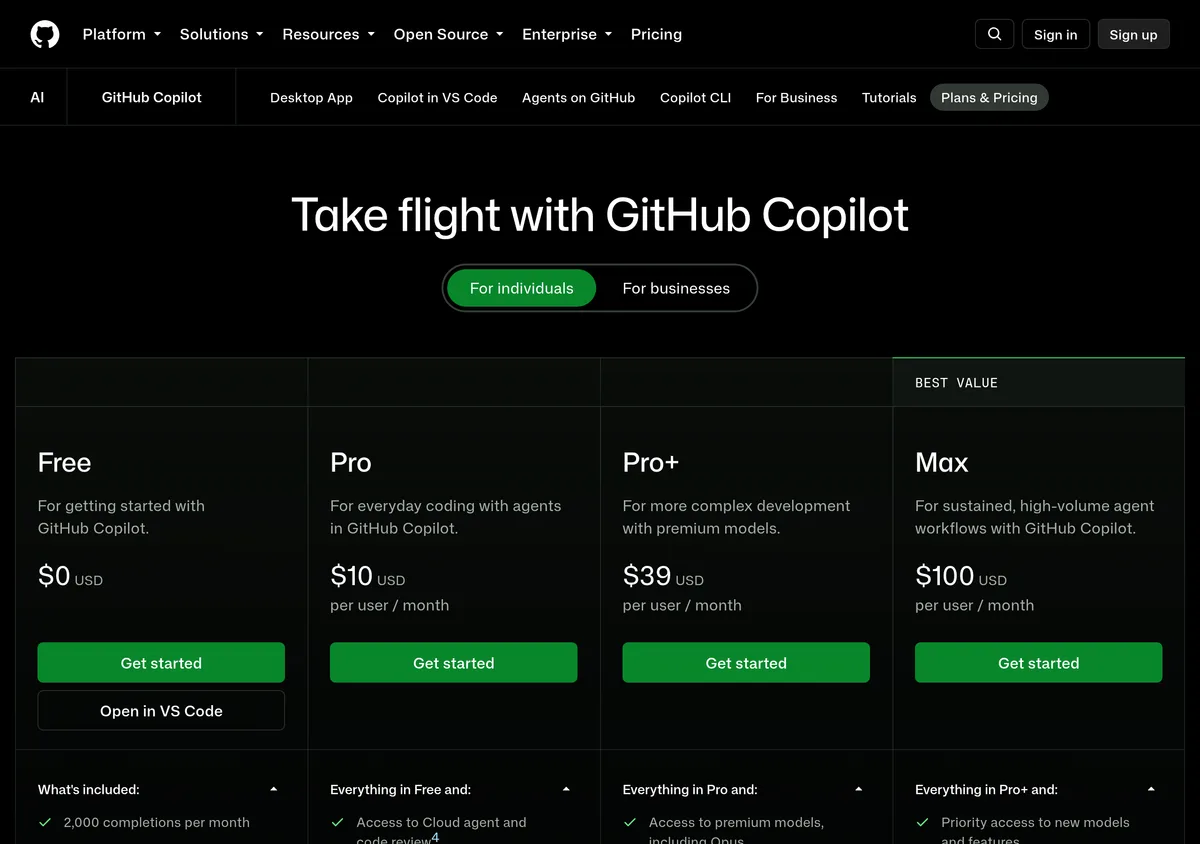 Source: github.com, captured October 19, 2026.
Four settings decide whether a Copilot org bill stays flat:
- Paid usage is on by default. When the pool runs dry, usage continues at published rates unless an admin disables the "AI credits paid usage" policy in AI Controls (GitHub Docs). Decide this on day one.
- User-level budgets cap one person's draw from the pool plus any overage, and a $0 budget blocks the user at once. Copilot does not fall back to a cheaper model when a budget runs out; it stops (same GitHub doc).
- Code review is billed twice. Each review uses AI Credits and also runs on GitHub Actions, consuming Actions minutes (GitHub models and pricing). The Default review effort level moved from Lite to Balanced on September 28 unless you had picked Lite explicitly (GitHub Changelog). If review spend rose in October, check that setting first.
- Credits reset on the calendar month, at 00:00 UTC on the first, and unused credits are forfeited (GitHub Docs).
The summer cushion is gone, too. Existing Business and Enterprise customers got promotional credits of $30 and $70 a seat for June, July and August only (GitHub blog). September was the first month on the bare allowance. If your pool felt roomy over the summer, rerun the numbers on your September invoice.
Candid con: Copilot Enterprise is not a $39 seat. GitHub's docs describe it as the plan for enterprises using GitHub Enterprise Cloud (GitHub Docs), and that seat lists at $21 per user per month (GitHub pricing). Unless you already pay for Enterprise Cloud, budget $60 per developer. For the individual tiers (Pro, Pro+ and Max) and per-model rates, our Copilot plans guide has the full breakdown.
Cursor: two price lists since October 12
Cursor now runs two price lists. New customers start on The X Subscription; teams created before it keep their legacy Standard and Premium seats unless they choose to switch (Cursor docs).
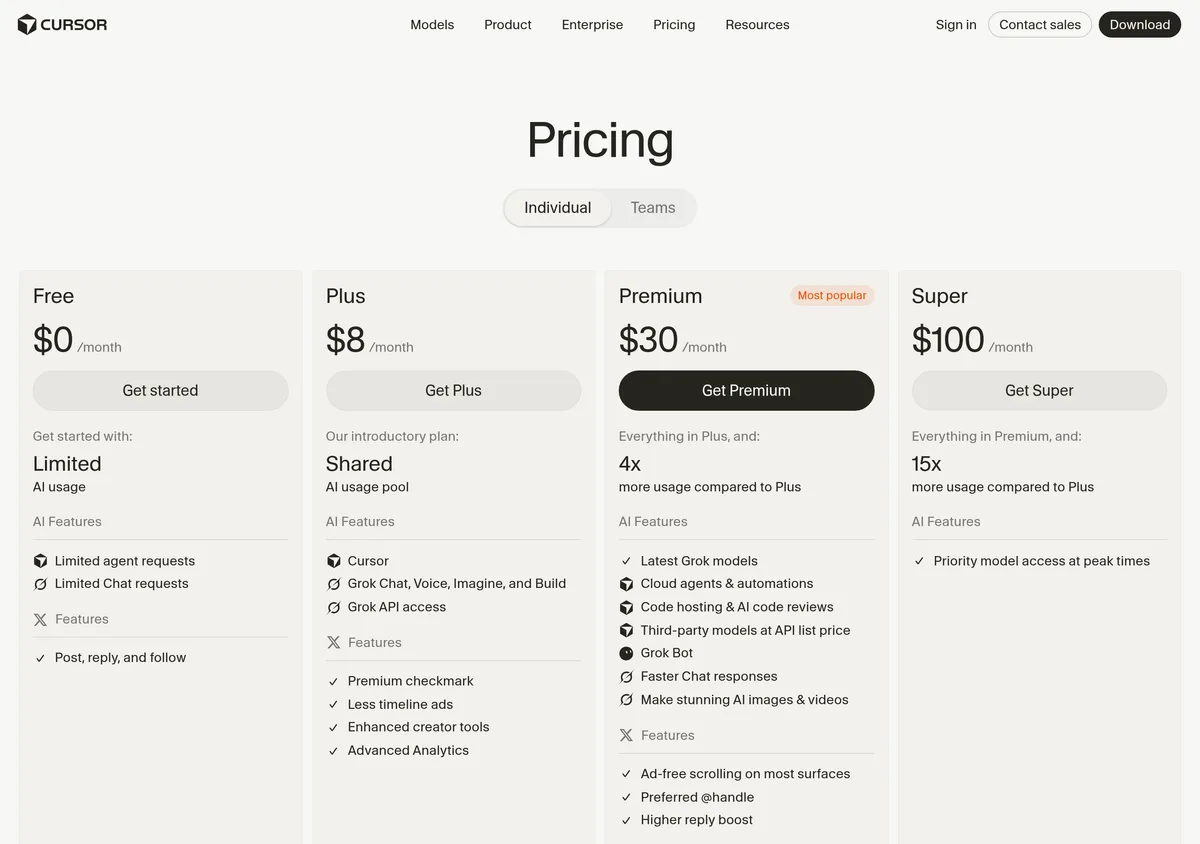 Source: cursor.com, captured October 19, 2026.
On the new plan, a team picks a seat tier per person: Premium at $30, Super at $100 or Ultra at $200, mixed freely on one team (Cursor docs). Plus at $8 is not sold to teams. Each paid seat gets its own weekly pool for Cursor's models (Grok 4.7, 4.6, 4.5 and Composer 2.5), and seats do not share pools with each other. Anything outside that pool, which means every Claude, GPT and Gemini request, is paid from a prepaid team balance at the model's list price plus a Cursor Token Rate of $0.25 per million tokens (same Cursor docs). The Token Rate applies to input, output and cached tokens, and it applies to requests made with your own API key as well.
For a team, that rewrites the bill. Composer 2.5 lists at $0.50 per million input tokens and $2.50 output, against $2 and $10 for Claude Sonnet 5.5 and $4 and $20 for Claude Opus 5.5 (Cursor docs). A team that keeps most agent work on Composer and Grok gets a cheaper seat than last month. A team that picked Cursor to run Claude all day now pays a $30 seat plus metered Claude.
Example: a 10-seat Cursor team that sends 400 million third-party tokens a month (input, output and cache combined) pays 400 x $0.25 = $100 in Cursor Token Rate, on top of the models' list prices and the 10 x $30 = $300 in seats. Token volume is our assumption; rates per Cursor's Team Pricing docs.
Legacy teams have a real decision. Standard seats at $40 and Premium seats at $120 keep their monthly Other Models pool, which covers third-party usage at each model's API price (Cursor legacy-plans docs). The X Subscription drops that pool. Switching is permanent, and Cursor's help page says support cannot undo it (Cursor help). If your team runs mostly on Claude, stay on the legacy seats. If it runs mostly on Composer, model one month of per-member usage at the new rates before you click Unify.
Spend controls are decent. Admins set one monthly additional-usage limit for the team, a default per-member limit and per-member overrides; when the team limit is hit, paid usage pauses even if prepaid credit remains (Cursor docs). Our Cursor review covers the editor itself and the individual plans in more depth.
Claude Code: a seat with limits, or straight API metering
Claude Code comes with Claude's own plans rather than its own price list. Claude Pro is $20 billed monthly, or $17 a month on the annual plan, and includes Claude Code; Max runs $100 for 5x Pro's usage (Anthropic) and $200 for 20x (Anthropic help center).
Teams have two routes. Claude Team seats are $25 a month for Standard and $125 for Premium, or $20 and $100 billed annually, for 2 to 150 people, with seat types mixed freely (Anthropic). Each member's Claude Code usage draws from a per-seat allowance that resets on a rolling five-hour window and a weekly window, shared with Claude chat; to go past it, an admin turns on usage credits and sets spend limits by organization, group or member (Claude Code docs). Claude Enterprise is a different shape: $20 per seat per month billed annually with a 20-seat minimum, plus all usage at API rates (Anthropic).
Anthropic publishes its own Claude Code spend data:
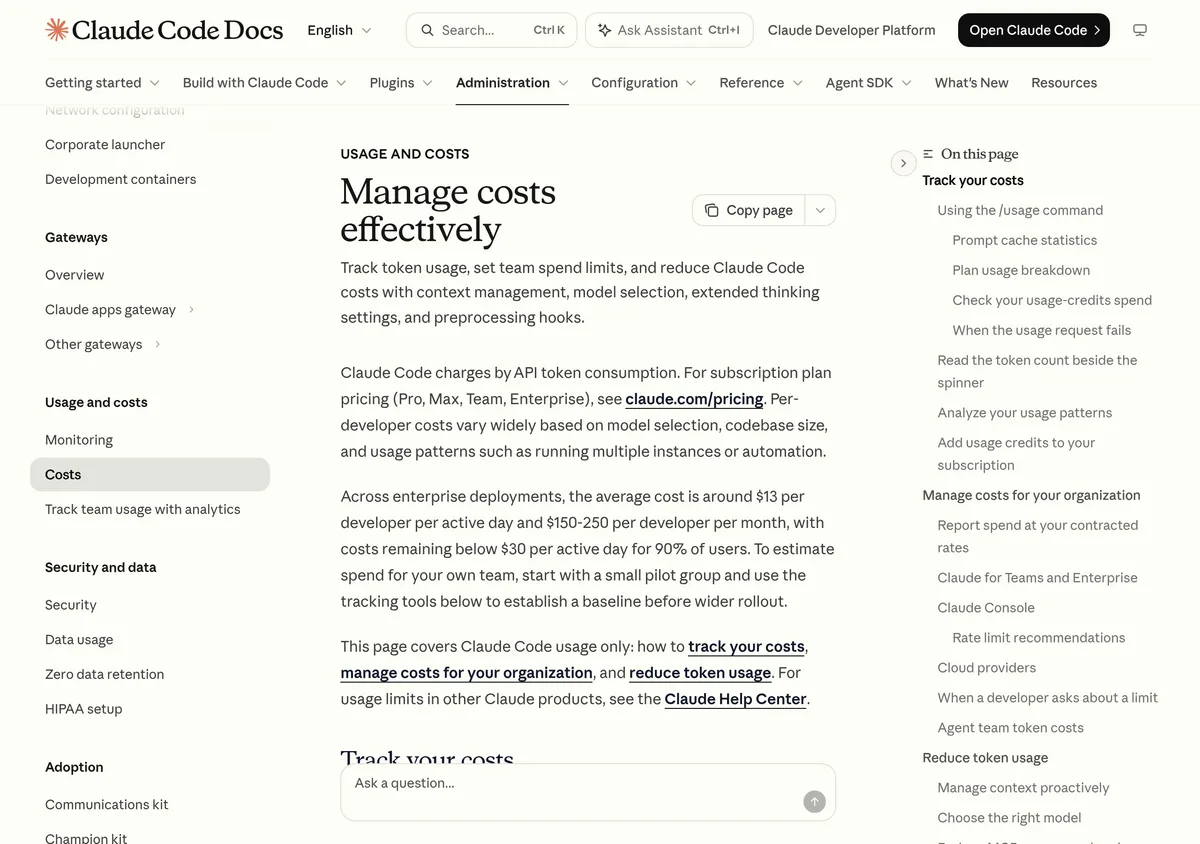 Source: code.claude.com, captured October 19, 2026.
Across enterprise deployments, the average is around $13 per developer per active day and $150 to $250 per developer per month, with 90% of users under $30 per active day, per Anthropic's Claude Code cost docs. Those are API-rate dollars, so they map straight onto Claude Enterprise, where every token bills at API rates. On Team seats they tell you something else: which developers will outgrow a Standard allowance and need Premium or usage credits.
Candid con: the seat allowance is not a dollar figure. Usage inside it isn't metered in dollars, so you only see spend once members go past the allowance into usage credits (Claude Code docs). Plan your pilot around the spend report, not the seat count.
Windsurf is now Devin Desktop
Cognition renamed Windsurf to Devin Desktop on June 2, 2026, keeping the IDE and replacing the Cascade agent with a rewritten local agent called Devin Local (Cognition). The old pricing URL now redirects to Devin's.
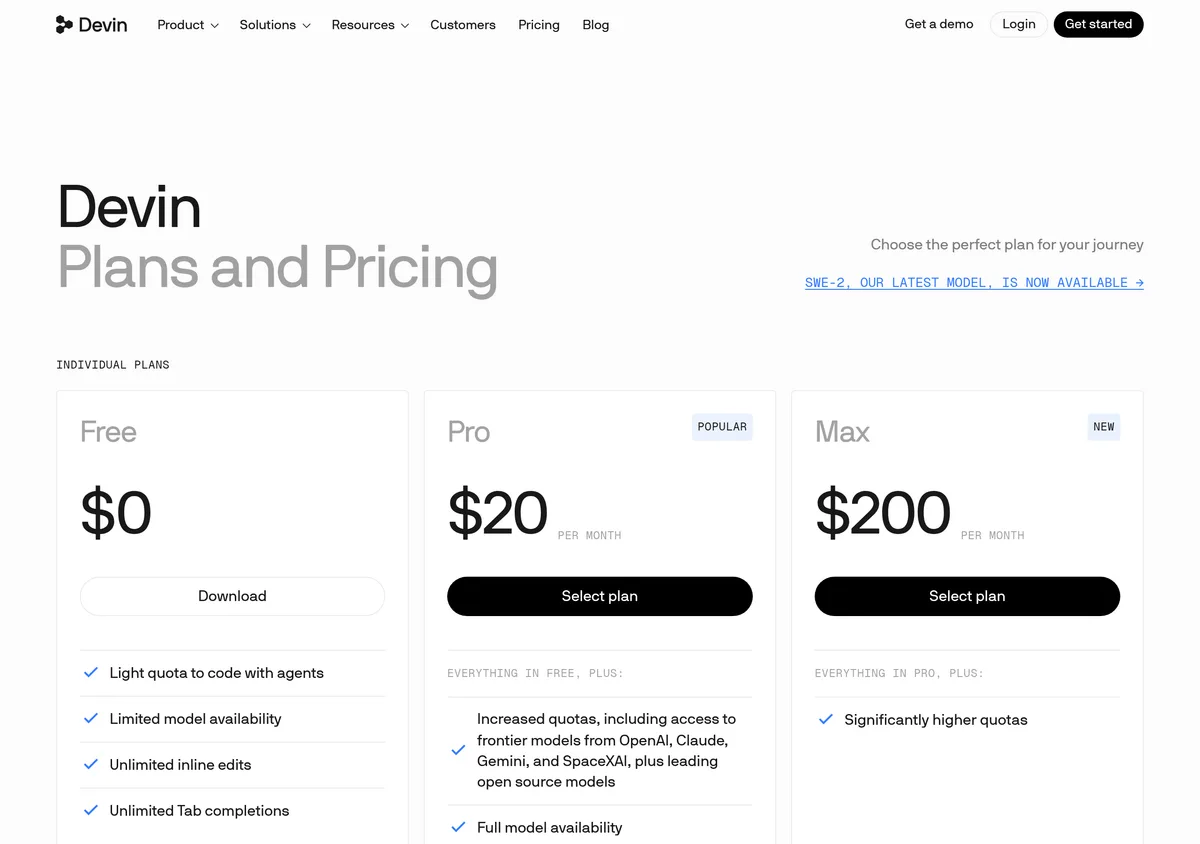 Source: devin.ai (redirected from windsurf.com/pricing), captured October 19, 2026.
Pro is $20 a month and Max $200. The Teams plan is priced differently from everyone else here: $80 a month for the team plus $40 per full developer seat, for up to 200 users (Devin pricing). Allowances refresh daily and weekly, and extra usage is bought at API pricing (same Devin page). It suits teams that want one editor managing Devin cloud sessions alongside other ACP-compatible agents. Watch the flat team fee: at 10 seats it works out to $48 a head, above Copilot Business, Claude Team Standard and Cursor's Premium seat (prices per the vendor links in the table above).
What a 10-person team pays before anyone runs an agent
Seat cost is the floor. Here is that floor for a 10-developer team on monthly billing, using the list prices in the table above.
Seat floor, 10 developers, per month (list prices, October 19, 2026)

Copilot Business        10 x $19                 = $190
Claude Team Standard    10 x $25                 = $250   ($200 on annual)
Cursor Teams Premium    10 x $30                 = $300   (+ third-party usage)
Cursor legacy Standard  10 x $40                 = $400   (existing teams only)
Devin Desktop Teams     $80 + 10 x $40           = $480
Copilot Enterprise      10 x ($39 + $21 GHE)     = $600
The ranking flips once agents run. Assume one medium agent session reads 200,000 input tokens and writes 50,000 output tokens, with caching ignored.
Example: on Claude Sonnet 5.5 at $2 input and $10 output per million tokens, that session costs 0.2 x $2 + 0.05 x $10 = $0.90. On Claude Opus 5.5 at $4 and $20, it costs $1.80. On Claude Haiku 5.5 at $0.10 and $0.50, it costs under 5 cents. Those per-token rates are identical on Anthropic's pricing page, Cursor's model table and GitHub's rate table. Session size is our assumption, not a measurement.
Example: two developers on that team each run 10 Opus 5.5 sessions a workday for 22 workdays. That is 440 sessions x $1.80 = $792 a month of model usage. On Copilot Business, it eats 79,200 credits against a 19,000-credit pool and bills the rest as overage. On Cursor's new Teams plan, all of it is metered third-party usage plus the Token Rate. On Claude Team, the two of them belong on Premium seats, which carry 5x a Standard seat's allowance per Anthropic.
What decides the bill is who runs agents, on which model, and whether the plan includes that model's usage. For other team sizes, our AI coding cost calculator does the seat math; check its as-of date against this page, since Cursor's list changed on October 12.
Four ways to cut the bill
- Audit seats before you renew. Pull a month of usage and remove or downgrade anyone who hasn't used the tool in 30 days. On Copilot, a removed seat only shrinks the pool next cycle, so do it before the month turns (GitHub Docs).
- Route by model. Haiku 5.5 is a fraction of Sonnet 5.5's price, and Sonnet 5.5 is half of Opus 5.5 on both input and output (Anthropic). Make the cheap model the default and escalate when a task needs it. On Cursor's new plans, Composer 2.5 inside the weekly pool costs nothing extra (Cursor docs).
- Let caching work. A cache read on Opus 5.5 costs $0.20 per million tokens against $4 for fresh input (Anthropic). Agents resend the same system prompt and files every turn, so keep one model per thread, point the agent at the files a task touches rather than the repo root, and start a fresh thread when you switch problems.
- Batch the work that can wait. On the Claude API, batch processing saves 50% (Anthropic). Test generation, doc passes and bulk refactors don't need an answer in ten seconds.
The pick, by team
| Team | Pick | Where it flips | Source for price |
|---|---|---|---|
| Solo developer, mostly completions and chat | Copilot Pro at $10 | You want Opus in the picker: Pro+ at $39 | GitHub |
| Solo developer who wants an AI-native editor | Cursor Premium at $30 | Most of your agent work runs on Claude, which bills at API list price on top of the seat | Cursor docs |
| 5-person startup on GitHub | Copilot Business at $19 a seat | Most agent work runs on Composer or Grok: Cursor Teams Premium seats | GitHub Docs |
| Claude-first team, terminal workflows | Claude Team Standard at $25, Premium for the heavy users | You need SCIM and audit logs: Claude Enterprise | Anthropic |
| 50-person org | Copilot Business at $19 with user budgets on day one | You already pay for GitHub Enterprise Cloud: Enterprise adds the larger pool | GitHub Docs |
Before you migrate a legacy Cursor team, price the Claude share at list plus the Token Rate, per Cursor's Team Pricing docs. If you're on Copilot, check your September invoice: it's the first month without GitHub's promotional credits (GitHub blog).
What changed
- 2026-10-19: Rebuilt the page for teams. Re-verified every price against vendor pages and replaced all third-party aggregator sources with vendor links. Added Cursor's October 12 X Subscription seats and the Cursor Token Rate, Copilot's pooled AI Credits, the end of the summer promotional credits and the Balanced code review default, Claude Team and Enterprise seat prices with Anthropic's published Claude Code spend data, and Windsurf's rename to Devin Desktop. Merged in the useful parts of our Copilot vs Cursor pricing, Cursor vs Copilot teams pricing and cost-cutting guides, added a 10-person seat-floor comparison and dated screenshots of four vendor pages.
- 2026-06-26: First published.